Paper A in this series drew the regulatory line around the free-floating 406 MHz radio-positioning distress beacon (EPIRB): under SOLAS Chapter IV, IMO MSC.471(101), IEC 61097-2:2021 and ETSI EN 300 066, the approved beacon must keep transmitting for at least 48 hours after years of untouched storage, and its type-approved battery is therefore a non-rechargeable, expiry-dated primary lithium pack that no service agent may replace with a rechargeable chemistry. Paper B showed where sealed nickel-metal hydride lawfully belongs – the repeatedly cycled shore-side programmers, 406 MHz test receivers and decoders, portable combined GMDSS test boxes, rechargeable training beacons and workshop standby supplies. This Paper C closes the loop with the question an OEM or a flag-state surveyor asks next: how is such a sealed NiMH service pack tested, qualified and evidenced, and how does it fit into the annual test and shore-side maintenance of the EPIRB? The answer separates five distinct compliance layers – the beacon's own type approval, the radio test instrument's type and calibration, the NiMH cell performance standard, the safety standard for nickel-based cells and batteries, and transport classification – and assigns the pack maker a precise, defensible dossier. The governing documents are IEC 61951-2 for NiMH cell performance, IEC 62133-1 for nickel-based safety (the 2026 revision keeps the same core test set as the 2017 edition), IMO MSC.1/Circ.1040 for the annual EPIRB test and MSC.1/Circ.1039 for shore-side maintenance at intervals not exceeding five years. The beacon's approved primary lithium battery remains entirely out of scope and untouched.
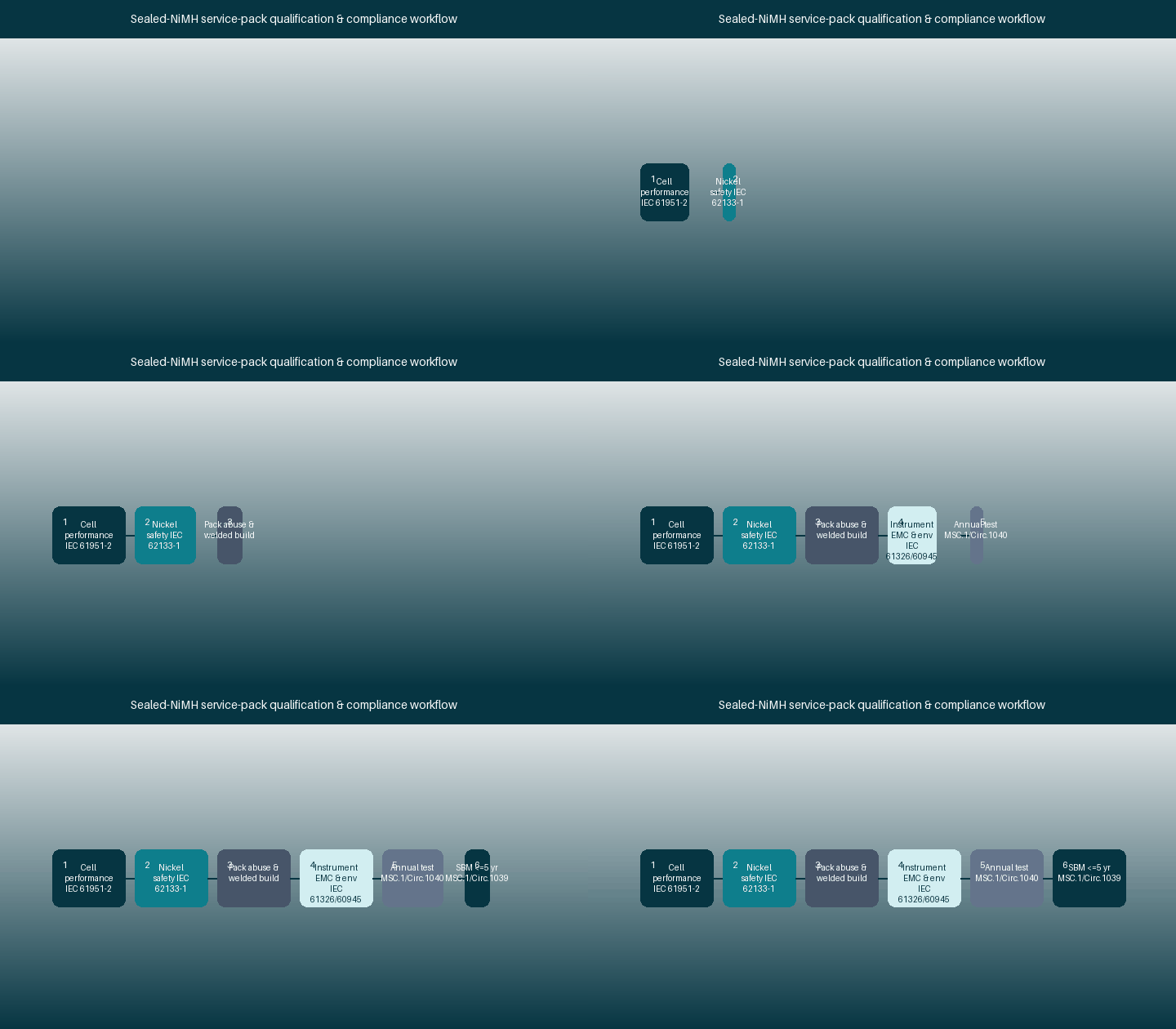
A common audit error is that a service-tool vendor claims – or a buyer assumes – that one certificate covers the entire EPIRB test chain. It does not. The first layer is the distress beacon's own type approval under IEC 61097-2, the Cospas-Sarsat documents C/S T.001 and T.007, ETSI EN 300 066 for the 406 MHz signal and EN 300 152 for the 121.5/243 MHz homing signal; that approval belongs to the beacon maker and is voided by any unapproved battery swap. The second layer is the test instrument itself – the 406 MHz test receiver, the programmer or the combined GMDSS test box – which carries its own radio, EMC and environmental qualifications and, crucially, a calibration that makes its measurements legally meaningful. The third and fourth layers are the rechargeable battery inside that instrument: cell performance to IEC 61951-2 and cell/battery safety to IEC 62133-1. The fifth layer is transport classification. The NiMH pack maker owns layers three and four and supplies evidence for layers two and five; it never owns layer one and must never imply that it does. The first animated figure lays out the qualification and compliance sequence in the order a competent service-equipment OEM should assemble the file.
IEC 61951-2 (the 2017 edition with amendment A1:2022) sets the marking, designation, dimensions, tests and requirements for portable, sealed secondary nickel-metal hydride cells and batteries – small prismatic, cylindrical and button formats – that can be used in any orientation. For a service-instrument developer this standard is the common technical language in which the cell maker should deliver the data behind the catalogue: rated capacity under the standard charge/discharge regime, the charge-retention (self-discharge) figure that decides whether a tester left in a bag for weeks still works, the endurance (cycle) behaviour, charge and discharge end voltages, and dimensional and polarity compliance. The standardised tests outweigh any single peak-capacity figure, because the Paper B load is a low standby receiver current interrupted by short decode pulses: a cell with high 0.2C capacity but poor high-rate voltage behaviour can still pull a receiver below its cutoff. The procurement file should therefore demand the IEC 61951-2 test report together with supplementary high-rate and low-temperature discharge curves measured at the instrument's actual pulse, rather than accepting only the standard's reference conditions. Low-self-discharge (LSD) chemistries are specified for instruments that may wait for weeks between surveys, and the charge-retention clause is where that claim is verified rather than asserted.
The safety of portable, sealed secondary nickel cells and batteries is governed by IEC 62133-1; developers must watch the part number carefully, because IEC 62133-2 is the lithium-systems part and is cited only when a lithium-ion alternative is being evaluated. The standard covers tests for intended use and reasonably foreseeable misuse, with the pass criterion stated as no fire, no explosion and no electrolyte leakage. At cell level the programme includes low-rate continuous charge, vibration, thermal cycling, external short circuit, free fall, mechanical shock (impact), thermal abuse (temperature shock), moulding (pressure exposure), low pressure, overcharge, forced discharge, a nickel-specific wrong-installation test, and marking and packaging inspection. At battery (pack) level, vibration, housing stress at high ambient temperature, thermal cycling, external short circuit and overcharge of the assembled battery are added, together with venting/pressure-relief and temperature, voltage and current management requirements. The 2026 revision – the first substantial update in nine years – tightens structure and compliance logic but, according to the published summaries, introduces no new test items and keeps the same core scope and pass criteria, so a dossier built on the 2017 edition can be carried forward smoothly. The pack must also provide a pressure-relief path; where cells are embedded in a holder or potting compound, the potting must neither overheat the pack in normal operation nor block the vent.
| Qualification item | Governing document | What it justifies for the service tool |
|---|---|---|
| Capacity, charge retention, endurance, dimensions | IEC 61951-2:2017+A1:2022 | Delivered energy, shelf readiness and form factor of the NiMH cells |
| Safety in use and misuse (cell and pack) | IEC 62133-1 (nickel systems) | No fire / no explosion / no leakage under charge, short circuit, drop, shock, crush, thermal and overcharge stress |
| Instrument EMC and environmental performance | IEC 61326; aligned to IEC 60945 for ship radio | The tester neither emits nor suffers interference and survives radio-room / deck environments |
| Legally meaningful measurements | ISO/IEC 17025 calibration by the service provider | Frequency, level and coding results are traceable and accepted by surveyors |
| Beacon annual test / overhaul | MSC.1/Circ.1040; MSC.1/Circ.1039 | Annual functional test; shore-side maintenance at least every five years |
| Transport of the rechargeable pack | General battery-packaging rules (not UN 38.3 / Class 9) | NiMH is not a lithium battery; terminals protected against short circuit |
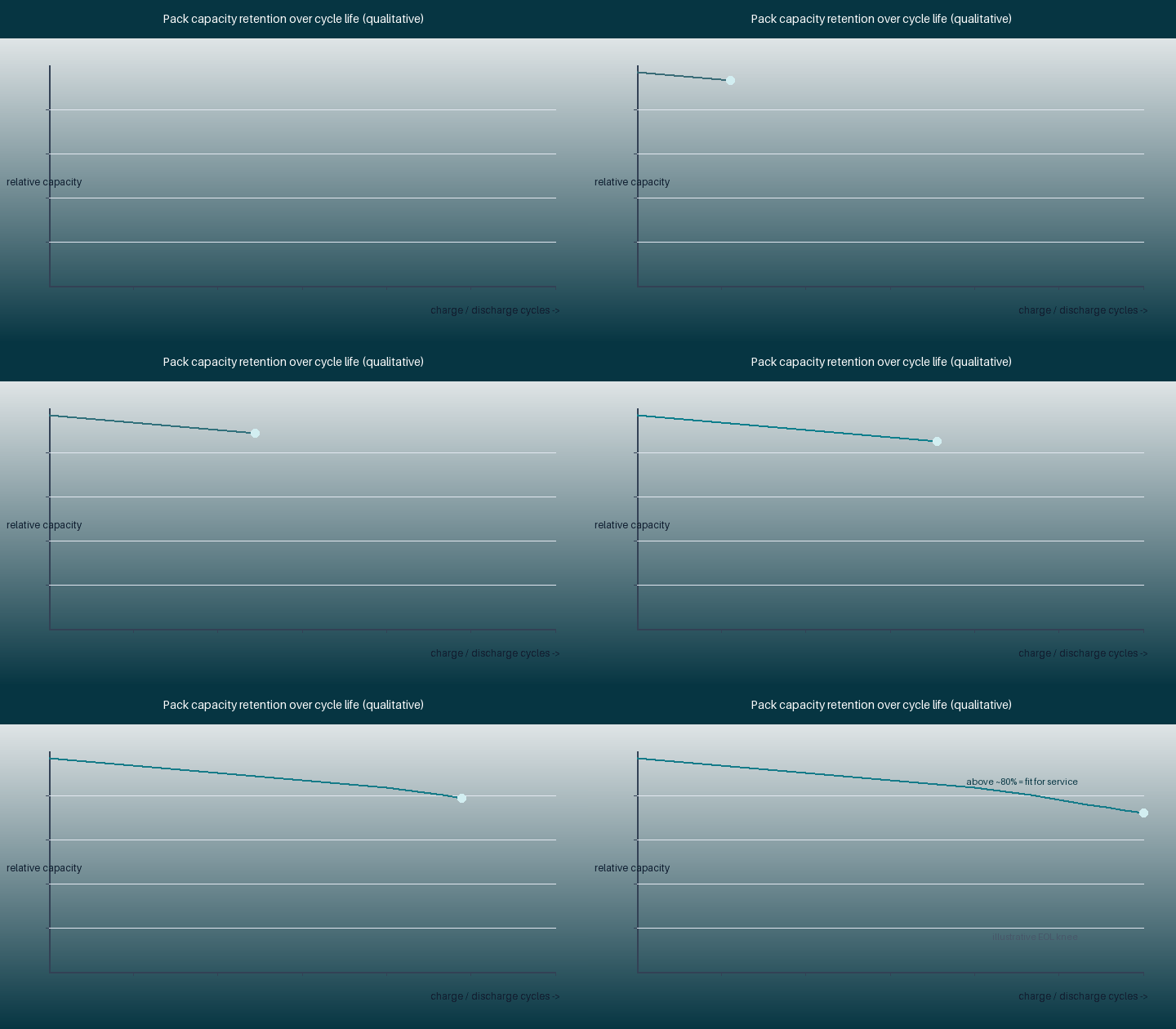
Cell standards alone do not qualify a pack that travels to sea. A pack for service instruments is additionally qualified against its real mechanical and thermal environment: vibration and shock for carriage on open decks, the high and low temperature limits of cold radio rooms and hot bridge cabinets, and ingress protection where the instrument is used outdoors. Welded cells with solder tabs, or a fully welded pack, are preferred over loose cells in spring holders, because an intermittent contact during a decode pulse creates exactly the false beacon fault a surveyor cannot afford. Charger and pack are validated together – constant-current charge with negative-delta-voltage cutoff (-dV/dt), delta-temperature-per-time (dT/dt) as backup and an absolute temperature cutoff, with charging restricted to the permitted temperature window – so that a technician's overnight top-up does not quietly destroy the cells. Above the battery, the instrument's EMC and environmental performance is declared to IEC 61326 for measurement, control and laboratory use and, where it is placed on the market as ship-radio-associated equipment, aligned to IEC 60945; the calibration that turns its readings into evidence is maintained by the recognised shore-side service provider under an ISO/IEC 17025 quality system. The second animated figure shows a qualitative charge-retention trend over cycle life; it illustrates the gradual fall-off and the end-of-life knee characteristic of an endurance test and is not a measured guarantee for any specific cell.
A practical advantage of sealed NiMH for a global service network is its transport status. The UN Manual of Tests and Criteria, section 38.3 (the T.1–T.8 tests, summarised in the UN 38.3 test summary), together with the Class 9 dangerous-goods documentation and lithium marks, applies to lithium-metal and lithium-ion batteries. Nickel-metal hydride is not a lithium battery and sits outside that regime, which greatly simplifies courier shipping of programmers, testers, training beacons and spare packs to service depots and vessels, and their carriage in a service technician's baggage. This is not a licence to ignore packaging: NiMH still travels under the ordinary packing instructions for battery goods, and metallic terminals must be protected against short circuit (individual caps, inner bags or non-conductive separation), parcels should be packed against crushing and accidental activation, and the consignment must, where required, carry the correct general battery-handling labels. The distinction must be kept sharp inside the same service kit, because the EPIRB's spare primary lithium battery and any lithium-ion spare part are Class 9 shipments that do require UN 38.3 summaries and lithium marks; a toolbox holding both must be documented chemistry by chemistry rather than assumed to be wholly nickel-based.
SOLAS regulation IV/15.9 and IMO MSC.1/Circ.1040 (Rev.2) require every EPIRB to be tested at intervals not exceeding 12 months for all aspects of operational readiness, with particular attention to frequency stability, signal strength and coding; the annual test may be carried out on board or at an approved test station, generally within three months before or after the anniversary of the radio safety certificate for cargo ships, and it includes verifying that the beacon has received shore-side maintenance under MSC.1/Circ.1039 at intervals set by the flag-state administration that may not exceed five years. MSC.1/Circ.1039 (Rev.1) recommends replacing the beacon's battery during this five-year maintenance and requires a self-test before and after maintenance with recorded results; the US eCFR Title 47 Part 80 mirrors the twelve-month interval and the same frequency/strength/coding focus. The sealed NiMH instruments are the means by which a competent person does this work – the portable 406 test receiver or combined GMDSS box decodes the burst and checks coding and level, and the programmer reads and writes the identity. Their own readiness is therefore a precondition for a valid annual test: a tester with an empty or uncalibrated rechargeable pack cannot deliver trustworthy results. The provider's quality system consequently governs the testers' calibration due dates, battery state of charge and health, and pre-use self-test, even though none of these procedures changes the EPIRB's own type approval or its prescribed, expiry-dated primary-lithium service kit.
A defensible acceptance file for a sealed NiMH pack for service tools should contain at minimum: the IEC 61951-2 cell-performance report plus supplementary high-rate and low-temperature curves; the IEC 62133-1 safety report for nickel systems covering both cell-level and battery-level tests with no-fire/explosion/leakage results and stating the edition used; cell datasheets and a pack drawing showing cell grade, series count, solder tabs, vent path, any NTC thermistor and thermal cutoff, and terminal protection; the charger specification with -dV/dt and dT/dt cutoff and temperature window; a pack-level vibration/shock and temperature declaration matched to deck and bench use; a transport declaration confirming the chemistry is nickel-metal hydride (not Class 9, outside UN 38.3), with packaging and short-circuit precautions; and batch/date coding for traceability. The instrument OEM adds its IEC 61326/60945 evidence and the ISO/IEC 17025 calibration, while the shore-side maintenance provider keeps the MSC.1039/1040 procedures and records. Once that separation is maintained, the rechargeable tools that lawfully keep the life-saving beacon on station are themselves qualified, ready and shipable – and the beacon's non-rechargeable, approved lithium battery stays exactly where its type approval requires it.
Weijiang Power manufactures sealed nickel-metal hydride cells and matched industrial packs for EPIRB programmers, 406 MHz test receivers and decoders, portable combined GMDSS testers, rechargeable training beacons and workshop standby supplies, and supplies OEMs and service-equipment partners with a complete evidence file: IEC 61951-2 performance reports, IEC 62133-1 safety test reports for nickel systems, high-rate and low-temperature pulse characterisation, pack drawings showing solder tabs, venting and thermal protection, charger co-validation, and a clear transport declaration outside Class 9. Send us your load profile, peak decode current, temperature envelope, autonomy target and the standards your tester must meet; our engineers will size, qualify and document a pack that stays calibration-ready across years of annual survey cycles. Browse the cell and pack range on the products page.


