Paper A in this series established the hard regulatory boundary of the float-free 406 MHz EPIRB: under SOLAS Chapter IV, IMO MSC.471(101), IEC 61097-2:2021 and ETSI EN 300 066, the distress beacon itself must run for at least 48 hours across -20 C to +55 C after years of untouched stowage, and its type-approved battery is therefore a non-rechargeable, expiry-dated lithium pack that no service agent may replace with a rechargeable chemistry. This Paper B turns to the equipment that keeps that beacon legal and trustworthy over its service life: the rechargeable test, programming, training and standby instruments used by shore-based maintenance providers and radio surveyors. Shore-based maintenance under IMO MSC.1/Circ.1039 (at intervals not exceeding five years) and annual testing under MSC.1/Circ.1040 depend on calibrated, portable, always-ready tools - 406 MHz test receivers and decoders, OEM programmers that write the 15-hexadecimal identification and MMSI, combined portable GMDSS test boxes covering EPIRB, AIS-SART, Navtex and VHF/DSC, rechargeable training and dummy beacons for drills and maritime academies, and the small uninterrupted power supplies that keep programmer PCs and label printers working in a service shop. Manufacturer service-tool guidance published for MSC.1/Circ.1039 work (for example the Jotron SBM equipment list, which names the Tron Unidec 406 MHz tester, combined 121.5/406 MHz testers, WST beacon testers and the Danphone Futronic GMDSS/AIS-SART test box) shows how this layer is actually equipped. For these repeatedly cycled, frequently recharged, cabin- and carry-on-friendly instruments, sealed nickel-metal hydride is often the most defensible chemistry choice. This paper walks through their load profiles, a chemistry comparison against Ni-Cd, lithium-ion and sealed lead-acid, a transparent cell-and-pack sizing method, charging and thermal design, and the correct standards files (IEC 61951-2 for performance and IEC 62133-1 for nickel-system safety), while keeping the approved primary-lithium beacon battery unambiguously out of scope.
The EPIRB service ecosystem separates cleanly into four battery duties, and confusing them is the root of most bad pack specifications. The first is the shore programmer and decoder used during the five-year overhaul, which reads and writes the beacon identity, exercises the GNSS self-test and decodes 406 bursts over a short bench session: its load is minutes of microcontroller and display current with brief RF activity. The second is the portable 406 MHz test receiver or combined GMDSS test box carried by the radio surveyor onto exposed decks and into cold radio rooms, which must listen for the 121.5 MHz sweep tone and decode a 406 burst on demand during a long day of ship visits, and so needs a large fraction of a working day of autonomy with long idle gaps. The third is the rechargeable training or dummy beacon used in abandonment drills and academies, which transmits repeatedly (at low power or into an attenuator/tester rather than to the satellite) and is recharged after every class. The fourth is service-shop standby or mini-UPS power for the programmer PC, label printer and test receiver during a power cut.
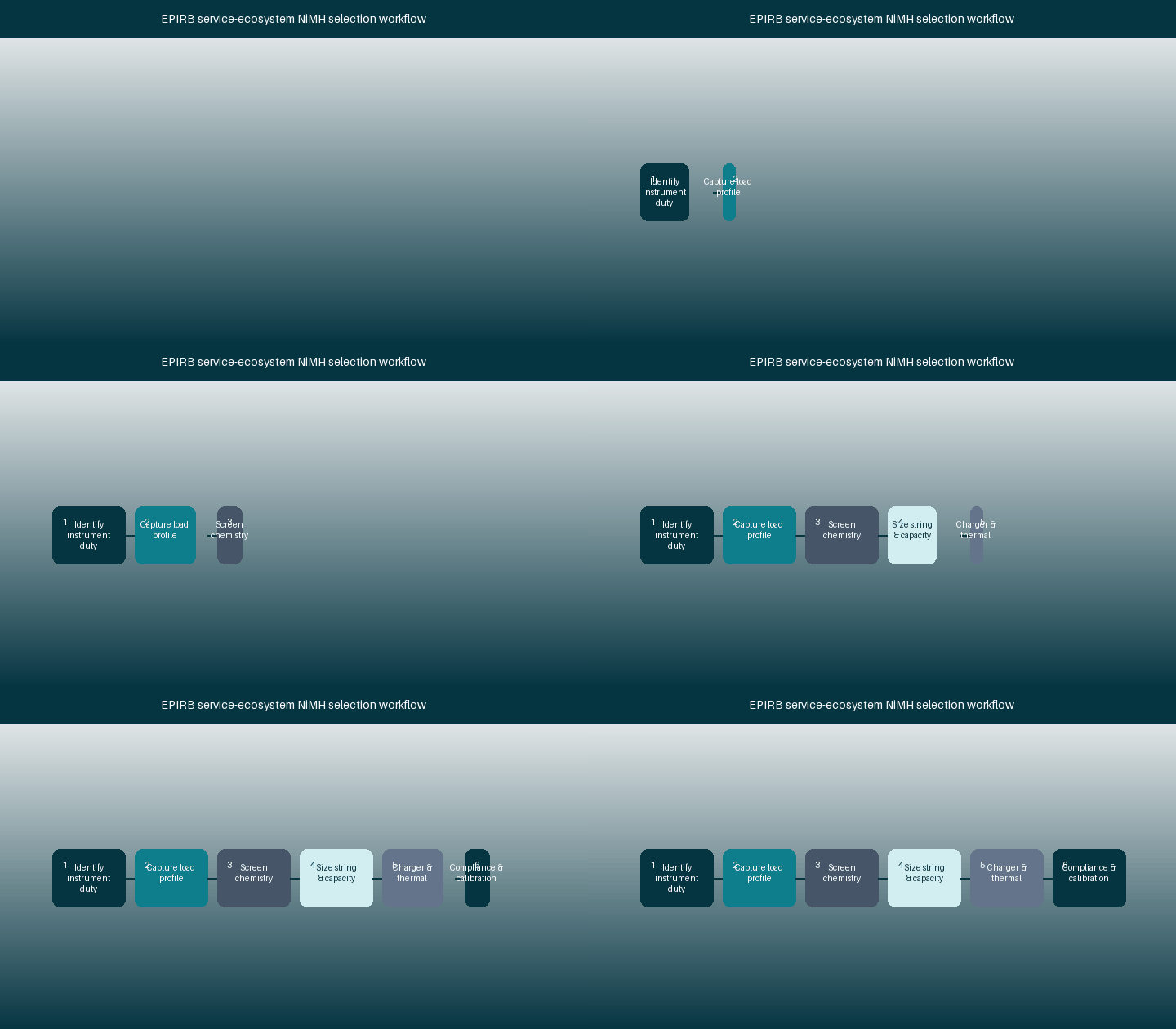
All four share the traits that favour sealed NiMH: they are discharged and recharged on a known schedule rather than left for years, they are handled and shipped constantly by service engineers, they must be ready without a lengthy pre-charge, and they operate in workshops and on deck across a wide temperature span. None of them carries the multi-year, zero-maintenance standby mandate that forces the distress beacon to primary lithium. The first animated figure sets out the selection workflow that follows, from identifying the instrument duty through to the compliance file that should accompany the pack.
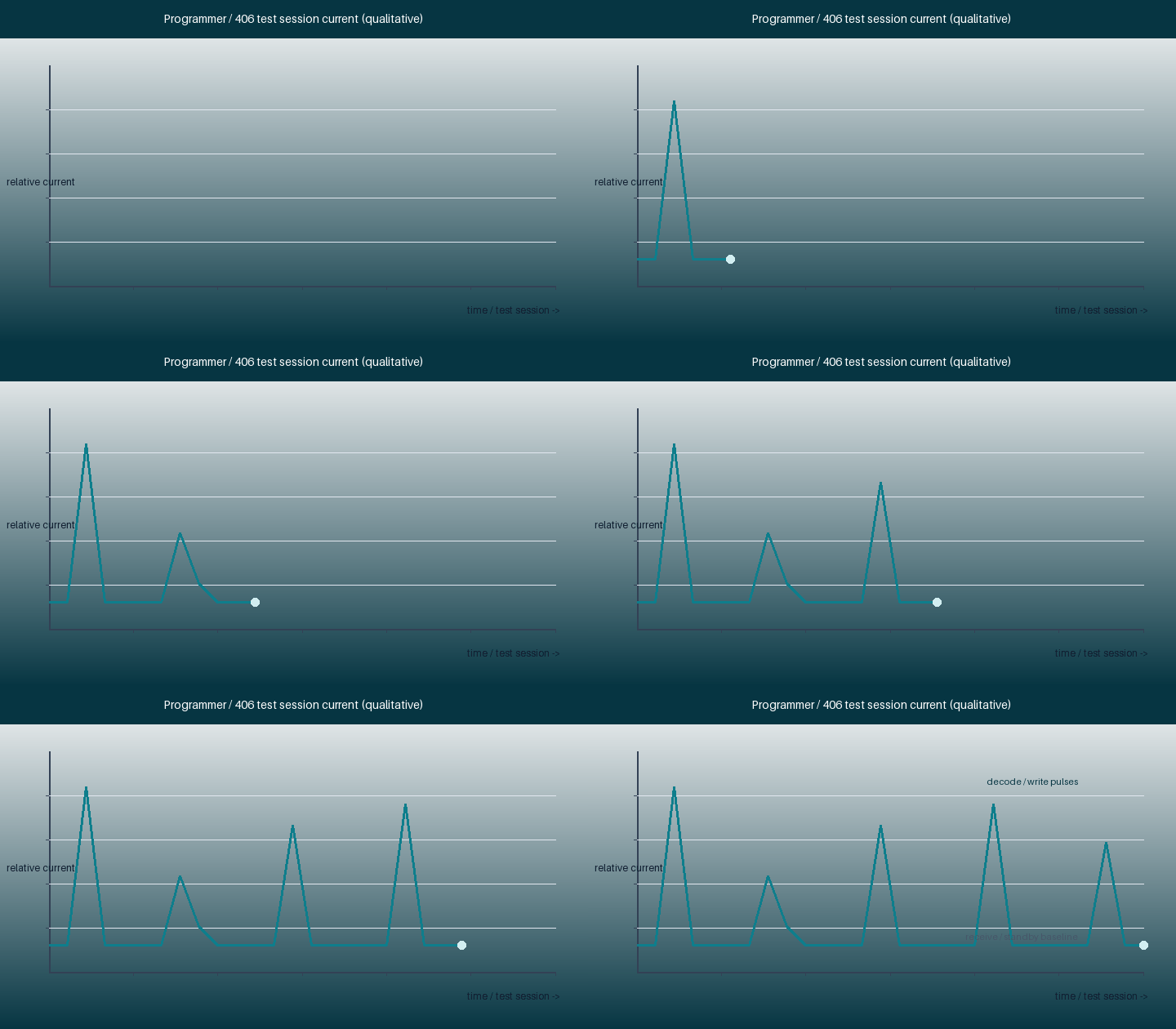
Each duty has a different shape of current. The programmer is dominated by a low housekeeping and screen baseline for most of the bench session, interrupted by short, higher-current events when it transmits to the beacon, writes the identity or runs a GNSS test. The portable test receiver spends most of its time in a sensitive receive/standby state, then draws a decode-and-display pulse when the surveyor triggers the beacon self-test; because a surveyor may test many vessels between charges, the average current and the self-discharge during weeks in a tool bag matter more than the peak. A training beacon mimics the real EPIRB profile - an activation peak, periodic GNSS fixes and repeated 406-class pulses with a homing carrier - but over a class schedule of perhaps an hour or two rather than 48 hours. The shop UPS is a long, near-zero float standby with occasional moderate AC-inverter or DC loads.
Specifying a pack from the nameplate current alone is a common error: RF test instruments have a high peak-to-average ratio, and a pack chosen only for average energy can sag below the receiver's cut-off voltage during a decode burst, producing false failures that look like a faulty beacon. The correct brief to a cell maker therefore captures five numbers for each instrument - the steady baseline current, the pulse current and duration, the pulses per session, the total session or shift autonomy target, and the worst-case ambient temperature - together with the acceptable end voltage. The second animated figure traces a qualitative programmer/test session, showing the receive baseline, short decode and write pulses, and the return to standby; it is illustrative of the wave shape rather than a measurement of any one commercial tester.
Four rechargeable chemistries are realistic for portable marine test gear, and the choice is a balance of robustness, transportability and cost rather than raw energy density. Sealed NiMH offers roughly 60-110 Wh/kg (typical vendor ranges), good high-current and cold-temperature behaviour, a forgiving charge regime, no liquid electrolyte to spill, and - critically for equipment flown and couriered worldwide by service teams - it is not a lithium battery, so it is outside the UN Section 38.3 lithium shipping regime and the Class 9 lithium documentation that lithium-ion packs attract. Nickel-cadmium is even more rugged and tolerant of abuse and cold, but its lower energy density, the memory effect and global cadmium restrictions make it a legacy choice. Lithium-ion wins decisively on energy density and pack weight for a full-shift handheld instrument, but it requires a protection/management PCB, a controlled charger, care with charging at low temperature, and the UN 38.3 summary and Class 9 shipping paperwork for service inventory; it is the right answer where minimum weight is worth that overhead. Sealed lead-acid is cheap and quiet for the bench UPS but is heavy, bulky and intolerant of deep discharge, which rules it out of handheld testers.
| Criterion | Sealed NiMH | Ni-Cd | Li-ion | Sealed lead-acid |
|---|---|---|---|---|
| Typical energy density | ~60-110 Wh/kg | ~40-60 Wh/kg | ~150-250 Wh/kg | ~30-50 Wh/kg |
| Cold / pulse behaviour | Good pulse, works below 0 C on discharge | Excellent | Weak when cold; no charging below 0 C | Poor when cold, heavy sag |
| Management needed | Simple charger; optional thermistor | Simplest | Mandatory protection/BMS | Simple, bulk/absorb/float |
| Transport / regulatory | Not Class 9; outside UN 38.3 lithium rules | Not Class 9; cadmium restricted | UN 38.3 + Class 9 lithium shipping | General battery rules; heavy freight |
| Best fit in this ecosystem | Programmers, testers, training beacons, standby | Legacy extreme-cold tools | Weight-critical full-shift handhelds | Bench/shop UPS only |
The honest conclusion is that sealed NiMH is the default for service and training instruments that are shipped often, used in cool conditions and maintained by people who are not battery specialists; lithium-ion is specified only when the weight saving is large enough to justify a BMS, a qualified charger and lithium transport for every service depot.
A sealed NiMH cell is nominally 1.2 V, so pack voltage is set by the number of cells in series: common nominal rails are 6.0 V (5S), 7.2 V (6S), 8.4 V (7S), 9.6 V (8S) and 12.0 V (10S), chosen to match the instrument's regulator input and its cut-off voltage. Capacity is then set by the energy budget. The method is to integrate the session current profile - baseline energy plus the sum of every RF pulse - into a required delivered energy, divide by the nominal pack voltage to obtain ampere-hours, and then apply two de-rating factors before selecting a catalogue cell: a cold/end-of-life factor (capacity is lower at the temperature extreme and after the warranted cycle count) and a utilisation margin so the cell is not routinely run to its knee. High-rate, low-internal-resistance cells are selected where decode or transmit pulses are sharp, because pulse sag rather than nominal capacity usually sets the minimum acceptable cell grade; welded tabbed cells or a welded pack, rather than loose cells in a holder, are preferred for equipment that travels to sea.
As a transparent, illustrative example only (not a measurement of a named tester), consider a portable combined tester drawing a 250 mW-equivalent average at a 7.2 V rail for an 8-hour survey shift. Average current is roughly 35 mA at nominal voltage, giving about 0.28 Ah of useful charge; applying a 1.25 cold/EOL factor and a 1.2 utilisation margin sets a design target near 0.42 Ah, so a 6S pack of 700-800 mAh high-rate AA or sub-C cells delivers a comfortable shift with margin for the decode pulses and for weeks of low-self-discharge storage. The same arithmetic on an OEM's measured profile, not on this illustration, is what should fix the production specification. Low-self-discharge (LSD) NiMH chemistries are specified for instruments that may sit in a bag for weeks between surveys, because they retain most of their charge where standard NiMH would need a top-up before use.
Sealed NiMH is forgiving but not charge-and-forget: a robust pack programme specifies the charge algorithm rather than leaving it to a generic wall adapter. Constant-current charging with a validated full-charge termination - negative delta-V (-dV/dt), with delta-temperature-over-time (dT/dt) as a backup and an absolute temperature cut-out - prevents overcharge, and a low maintenance current keeps an instrument that lives on its cradle topped up without cooking the cells. Charging is constrained to roughly 0 C to 40/45 C; unlike lithium-ion, NiMH discharge in the cold is strong, but charging a cold or hot cell still damages it, so a pack NTC feeding the charger (and, on higher-energy packs, a series thermal cut-out) is standard practice. Designers size cells and charger together so that a service engineer can top up overnight, and they document the storage state of charge for instruments that ship from the depot. Because the service team's failure mode is a dead tester on the surveyor's day aboard, the combination of LSD cells, a smart cradle and a clear charge/conditioning schedule matters more to field reliability than squeezing in the last 10 percent of capacity.
The battery evidence for a sealed-NiMH service instrument is built from the correct standards. Cell performance is characterised to IEC 61951-2 (portable sealed rechargeable nickel-metal hydride cells and batteries), and safety for the nickel chemistry follows IEC 62133-1 - note the part number carefully: IEC 62133-1 covers nickel systems, while IEC 62133-2 is the lithium-systems part that applies only if a lithium-ion alternative is chosen. Because NiMH is not a lithium battery, the pack is outside UN Manual of Tests and Criteria Section 38.3 and the Class 9 lithium shipping controls, which materially simplifies sending testers, programmers and spare packs to service agents and ships; it still travels under ordinary battery packaging and general dangerous-goods guidance, and metal terminals must be protected against short circuit. The instrument's own approvals sit above the cell: a portable marine-radio tester or GMDSS test box may declare EMC and environmental performance to IEC 61326 (electrical equipment for measurement and control) and, where it is marketed as marine radio-associated equipment, align with IEC 60945, while the calibration that makes its measurements legally meaningful is maintained by the service provider under an ISO/IEC 17025 quality system. Crucially, none of this touches the EPIRB's type approval: the test instrument only measures the beacon, and the shore-maintenance procedure replaces the beacon's own approved primary-lithium pack, memory battery, seals and desiccant as a controlled, expiry-dated service kit. Substituting the rechargeable service-tool chemistry into the distress beacon remains prohibited and voids approval.
A complete pack brief to a nickel-metal hydride manufacturer should state, at minimum: the instrument type (programmer, 406/test receiver, combined GMDSS tester, training beacon or standby pack); nominal voltage and cell count; baseline, peak and pulse-duration currents; required session or shift autonomy and the longest storage interval; operating and charging temperature limits; the required charge termination and any cradle or NTC provisions; target cycle life and warranty; the standards files needed (IEC 61951-2 performance data, IEC 62133-1 safety evidence, cell datasheets and pack drawings); mechanical requirements (welded tabs, shock/vibration and ingress protection for deck use); and labelling and packaging for transport. With that brief, a pack can be co-validated against the real instrument so that the tester which certifies the life-saving beacon is itself always ready, accurate and legal - while the beacon's mandated primary-lithium battery is left exactly as its type approval requires.
Weijiang Power manufactures sealed nickel-metal hydride cells and matched industrial packs for portable test, programming, training and standby equipment, and supports OEM and service-equipment partners with IEC 61951-2 performance files, IEC 62133-1 nickel-safety evidence, pulse-load and cold-temperature characterisation, welded-tab pack assembly and charger/pack co-validation. If you build 406 MHz programmers, EPIRB and GMDSS test receivers, training beacons or service-shop standby power, send us your load profile, peak current, temperature envelope, autonomy target and the standards your instrument must meet, and our engineers will size a pack that stays ready through years of survey cycles. Review the cell and pack range on the products page.


