Before lithium-ion took over the newest cordless platforms, the nickel-metal hydride Sub-C cell was the heart of almost every rechargeable drill, driver, vacuum and garden tool, and it remains the dominant service-replacement and industrial-pack cell today. The Sub-C - abbreviated SC - is a compact cylindrical 1.2 V format deliberately sized to deliver very high current from a small volume, almost always sold with welded tabs so that cells can be built into series-parallel 'stick' packs. If you have ever rebuilt a cordless-tool battery or an RC racing pack, you have handled Sub-C cells. This guide defines the format, separates capacity from discharge rate, explains how tabbed cells become certified packs, and sets out the engineering rules for replacing older nickel-cadmium Sub-C packs without shortening life.
The Sub-C is a specific cylindrical size. Production NiMH SC cells are roughly 22.2-23 mm in diameter and 42-44 mm long (datasheets commonly list 22.2 x 43 mm, with a mass around 54 g), which places the format between an AA cell (about 14.5 mm diameter) and a full C cell (about 26 mm). That intermediate volume is the point: it is large enough to store useful energy yet short and robust enough to pack tightly into a tool handle or a racing stick.
An SC cell is nominally 1.2 V, like all NiMH cells, with a recommended end-of-discharge around 1.0 V. Rated capacities vary by grade; general-purpose and high-capacity lines are commonly 2,400-3,300 mAh, with 3,000 mAh being the widely referenced standard (a typical SC3000 datasheet guarantees a minimum near 2,860 mAh when discharged at 600 mA to 1.0 V at 20 C), and premium high-capacity cells reaching toward the high 3,000s. High-rate cells deliberately trade some of that capacity for current capability.
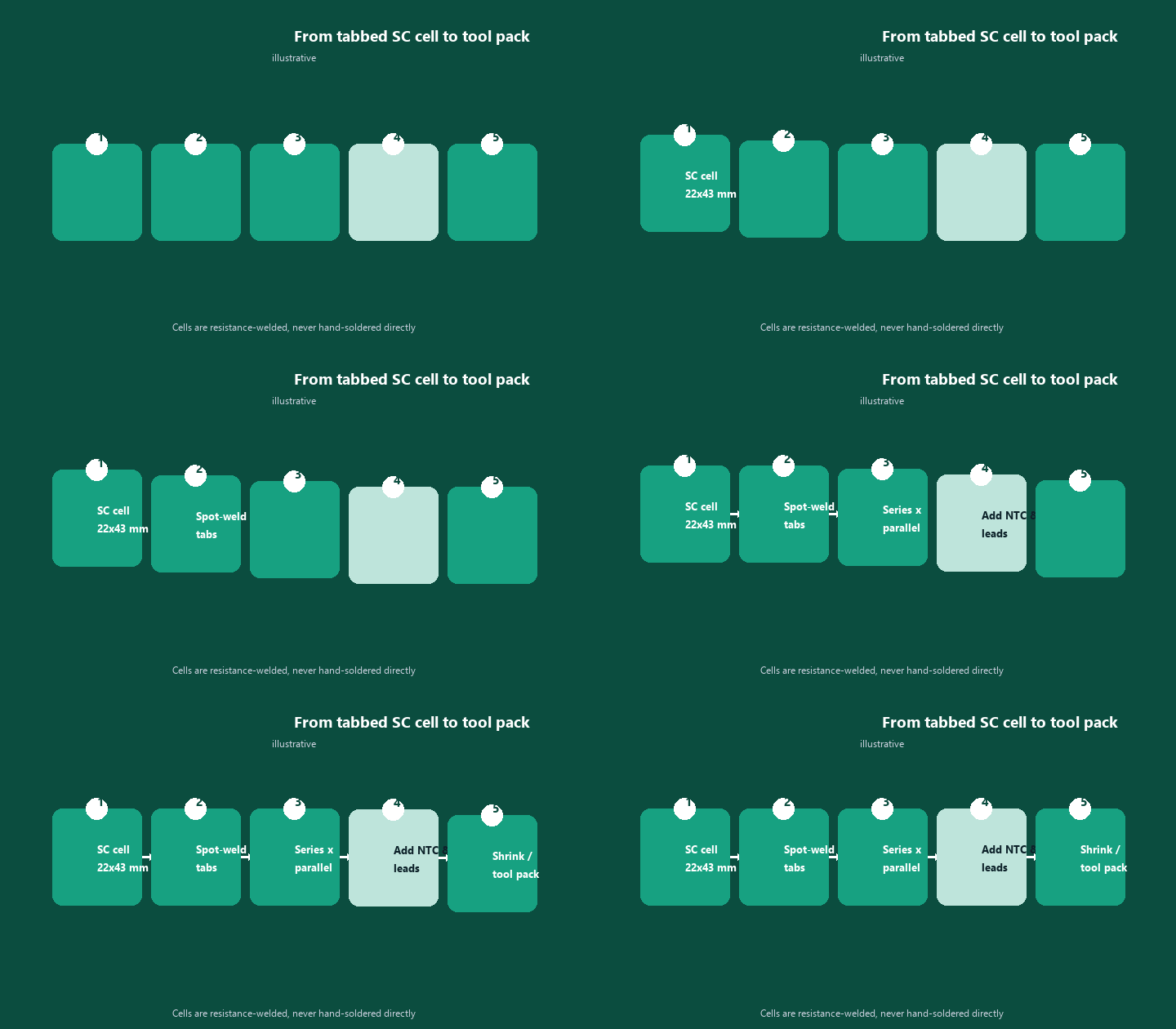
Service cells are supplied flat-top with solder tabs - thin nickel strips resistance-welded to the cell's top and bottom. Packs are then built by spot-welding tabs cell-to-cell into series strings (for voltage) and parallel groups (for capacity), adding a thermistor and leads, insulating with fishpaper or shrink, and enclosing the stick. Cells are welded, never hand-soldered directly: soldering iron heat can damage the safety vent and seal, which is why tabbed cells and proper spot-welding are non-negotiable in a quality pack.
The number buyers fixate on - 3,000 mAh - describes energy, but a power tool or RC load is governed by current. Discharge capability is expressed as a C-rate, where 1C for a 3 Ah cell is 3 A. High-rate Sub-C grades are routinely rated at 10C and 15C, implying continuous or burst capability on the order of 30 A to 45 A from a single 3 Ah cell - the kind of current a stalled drill motor or a launching RC vehicle demands for fractions of a second.
Cell designers achieve this with thinner electrodes, larger current-collector area, more conductive tabs and electrolyte formulations that lower internal resistance, often accepting a slightly lower nominal capacity than an energy-optimised cell of the same size. Choosing a maximum-capacity, low-rate SC for a high-current tool is a classic mistake: it runs hotter, sags harder under load and can deliver less usable runtime in the real tool than a lower-numbered high-rate cell that holds its voltage under the pulse.
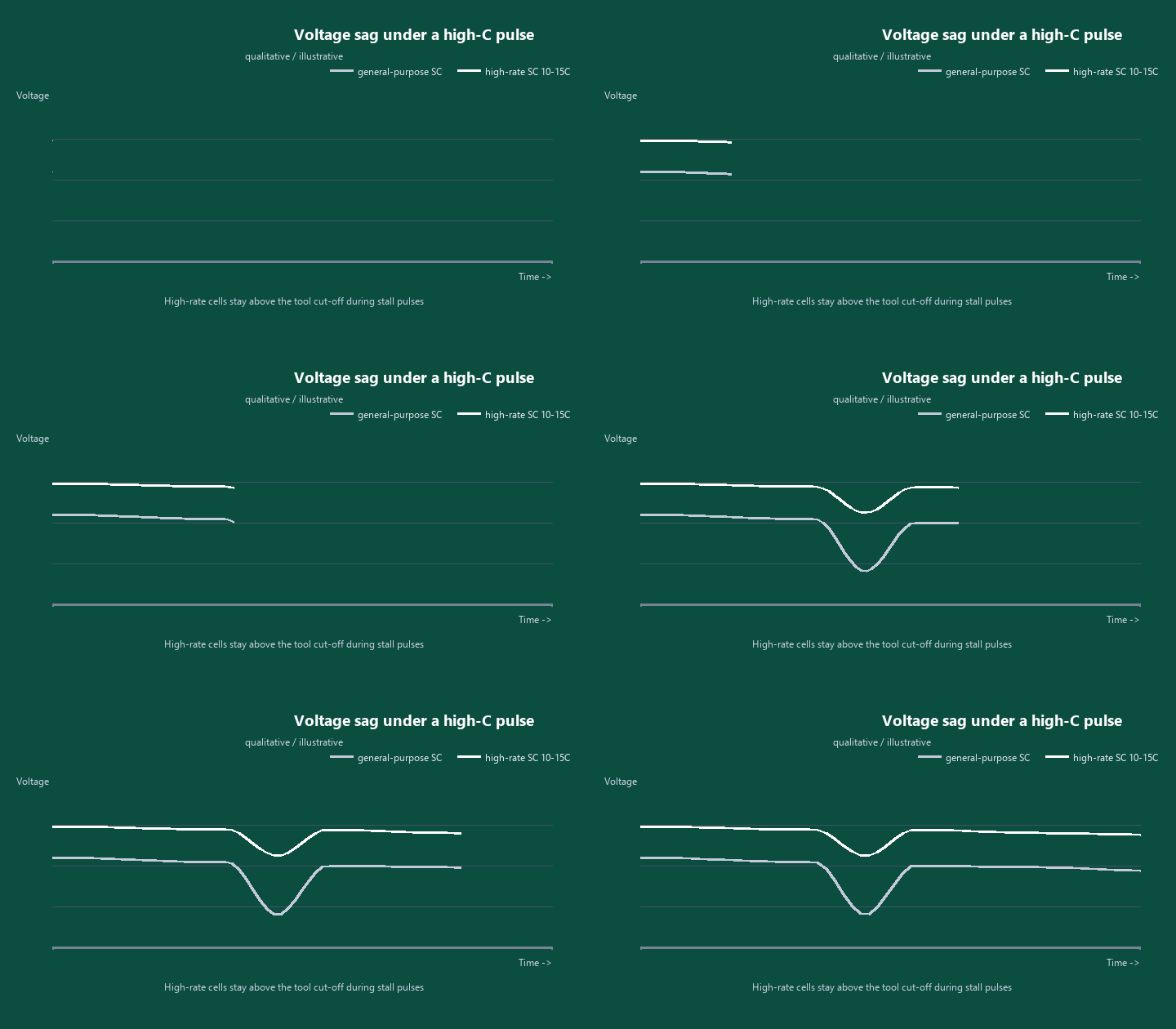
Under load the difference is visible as voltage sag. A high-rate SC keeps its terminal voltage high through a 10C pulse and recovers quickly; a general-purpose cell dips further and runs warmer, and repeated deep sag accelerates wear. Pack specifiers therefore select on a curve - voltage at the tool's actual stall and running currents - not on the capacity headline alone.
Millions of older cordless tools and industrial packs were built around nickel-cadmium (NiCd) Sub-C cells. NiMH SC cells share the same 1.2 V nominal voltage and the same cylindrical footprint, which makes them attractive drop-in upgrades offering substantially higher capacity and no cadmium - an important environmental and regulatory advantage under modern battery rules.
The swap is not entirely mechanical, however. NiMH and NiCd differ in charge acceptance, heat generation and full-charge signature. NiMH chargers rely on the sharper negative delta-V and temperature rise at end of charge; a charger designed only for NiCd can under- or over-charge NiMH, and NiMH is more sensitive to sustained high-temperature trickle charging. Rebuilding a pack with NiMH therefore means confirming the charger is compatible (or upgrading it), matching cell grade to the tool's current, and fitting an appropriate thermistor position so the pack can report temperature.
Never mix chemistries - or cells of different capacity, age or grade - inside one series pack. A pack is only as strong as its weakest cell, and mismatched cells reverse-charge or overheat as the string is driven. A correct NiMH rebuild uses a matched set of identically graded tabbed SC cells, clean welds, intact insulation and a verified charge and cut-off path; done properly it usually delivers both longer runtime and higher delivered voltage under load than the NiCd original.
Pack architecture starts from the required voltage and energy. A nominal tool voltage divided by 1.2 V sets the series count - 6 cells for 7.2 V, 10 for 12 V, 12 for 14.4 V, 15 for 18 V - while parallel groups multiply capacity and divide the current each cell must supply. High-current RC and tool packs frequently use matched high-rate cells in both series and parallel, with heavy nickel tabs and short, low-resistance interconnections to keep sag and heating down.
Thermal and protection design matters in NiMH packs even without the elaborate BMS lithium-ion requires. A thermistor (NTC) embedded against the cells feeds the charger and, on better tools, the tool's cut-off logic; pack layout should leave heat-spreading paths and avoid insulating the centre of a tightly-wrapped stick. Discharge should stop near 1.0 V per cell to prevent reversal, and chargers should terminate on -dV/dt, dT/dt or timer and avoid indefinite high trickle.
Beyond cordless drills and RC cars, tabbed SC cells appear in stick vacuums and hand vacs, garden and pruning tools, shavers and personal-care appliances, emergency and inspection lighting, portable fans and certain mobility and medical-support devices. For each, the specification exercise is the same: measure the running and stall current, the duty cycle and the thermal envelope, then choose the SC grade and series-parallel count that holds voltage across the worst-case pulse.
Sealed nickel-metal hydride cells and batteries are characterised under IEC 61951-2, which defines discharge, charge-retention and cycle-life test methods, while safety is addressed by IEC 62133-2 and transport qualification by UN 38.3 and IEC 62281. For OEM packs, regional marks and supplier test reports for capacity, internal consistency, abuse and transport complete the documentation set.
Cycle life is duty-dependent: under rated temperature, moderate discharge depth and proper charge termination, quality SC cells can deliver hundreds to around a thousand useful cycles, while sustained high temperature, deep reversal and overcharge cut that number sharply. Batch consistency - tight capacity and internal-resistance matching across welded cells - is what separates a pack that ages evenly from one that fails early through a single weak string.
Incoming and line checks for a pack builder therefore include cell capacity and voltage sorting (binning), weld-pull or resistance checks, NTC placement, a forming and self-discharge check, and a final discharge test at a representative current. A supplier that can provide cell-level traceability and these measurements will build far more consistent tool packs than one shipping un-binned commodity cells.
For tool brands, appliance makers, RC pack builders and after-market rebuild programs, the efficient route is to specify the SC cell and the finished pack together: cell grade (energy versus high-rate), tab style and orientation, series-parallel configuration, NTC and protection, leads and connector, shrink and labelling, and the charger it will be paired with. Supplying the measured duty cycle - running current, stall or peak current, pulse duration, allowed temperature and target runtime - lets a cell engineer select the right grade rather than the largest mAh number.
A capable NiMH manufacturer provides matched tabbed SC cells across the capacity range, builds welded packs with documented weld quality and thermistor integration, supplies IEC 61951-2 / IEC 62133-2 / UN 38.3 evidence, and co-validates charging so that -dV/dt and thermal termination suit the pack. That combination is what turns a commodity-looking 22 x 43 mm cylinder into a reliable, repeatable power source for a professional cordless product.
Even as lithium-ion expands into new platforms, the installed base of NiMH and NiCd Sub-C tools, the simplicity and safety of the chemistry, and the ease of field rebuilding keep the tabbed SC cell in steady, worldwide demand - which is why it remains a core line for industrial NiMH manufacturers.
Weijiang Power supplies sealed nickel-metal hydride cells and matched packs for consumer and professional products - high-drain AA and AAA cells for wireless audio, low-self-discharge 9 V (6HR61) blocks, and tabbed Sub-C cells welded into cordless-tool, appliance and RC packs. We support OEM, ODM and private-label partners with IEC 61951-2 performance files, IEC 62133-2 safety evidence, UN 38.3 / IEC 62281 transport documentation, pulse-load and capacity matching, and charger/pack co-validation. Tell us your duty cycle, peak current, cell or pack format, autonomy target and the standards your product must meet, and our engineers will specify a matched cell-and-pack combination. Review the range on the products page.


