Walk onto any airport ramp during a turnaround and the equipment clustered around an aircraft tells a clear story. Baggage tractors tow long trains of carts between the terminal and the stand, belt loaders lift luggage into the hold, and ground power units and conditioned-air systems keep the aircraft alive while its engines are off. A large share of these vehicles - most visibly the baggage and equipment tractors - have been battery-electric for decades, and the electrification that began with the tow fleet is now spreading into the higher-power equipment that once ran exclusively on diesel. This Paper A opens a three-part series on electric ground support equipment (eGSE) by explaining how battery power actually works on the ramp: which vehicles are electric, the standards they are built to, the shape of a real duty cycle, the electrical interface between ground equipment and the aircraft, and what the chemistry has to deliver. Papers B and C will turn this operating profile into a selection and sizing procedure and then a test and certification route. The boundary should be stated up front: this is ground-side equipment operating in the open air of the apron and inside cargo buildings, not the certified airborne emergency batteries covered in the earlier aviation series.
Ground support equipment is the broad term for the vehicles and fixed systems that service an aircraft between flights, and within it the electrified fleet divides into two groups by history. The first group was electric from the outset. Baggage and equipment tractors - the compact, low tow tugs that pull trains of baggage, cargo and mail carts - are conventionally battery vehicles, because their job rewards a quiet, manoeuvrable machine that produces no exhaust at the gate and can be recharged between shifts. The second group is electrifying now. Diesel engine emissions at the stand, airport air-quality rules and the falling cost of batteries have driven manufacturers to build battery versions of equipment with far higher and more sustained power demands: electric ground power units that supply the aircraft's electrical network, battery air-conditioning and preconditioned-air units, and, at the largest end, electric pushback tractors. The same vehicle families are also offered as hybrid or dual-energy machines, which use a small engine only when a battery alone cannot cover a long duty. The practical result for a battery supplier is a wide and growing set of duty profiles, from the modest, pulse-heavy traction pack in a tow tractor to the large, high-energy pack in a battery ground power unit.
European ground support equipment is designed against a paired set of standards, and understanding how the two divide is the quickest way to understand how the machines are qualified. EN 1915, Aircraft ground support equipment - General requirements, carries the rules that apply across the whole fleet: Part 1 covers basic safety requirements, Part 2 covers stability and strength requirements together with the calculations and test methods, Part 3 defines vibration measurement methods and reduction, and Part 4 defines noise measurement methods and reduction. EN 12312, Aircraft ground support equipment - Specific requirements, then breaks the fleet into equipment-specific parts, each governing one machine type. The parts most relevant to an electric ramp are Part 3 for conveyor belt vehicles (the belt loaders), Part 15 for baggage and equipment tractors, Part 16 for air start equipment, Part 17 for air conditioning equipment and Part 20 for electrical ground power units; other parts cover deicers, service stairs and platforms, lavatory equipment and the remaining vehicle families. The general standard supplies the common safety, stability and measurement baseline, while the specific standard adds the requirements unique to a tractor, a belt loader or a power unit. For an electrified model this split matters because the battery, its charger and its protective systems must satisfy both the horizontal safety rules and the equipment-specific demands - stability under a heavy battery pack, for example, and the noise and vibration limits set for the operator's station.
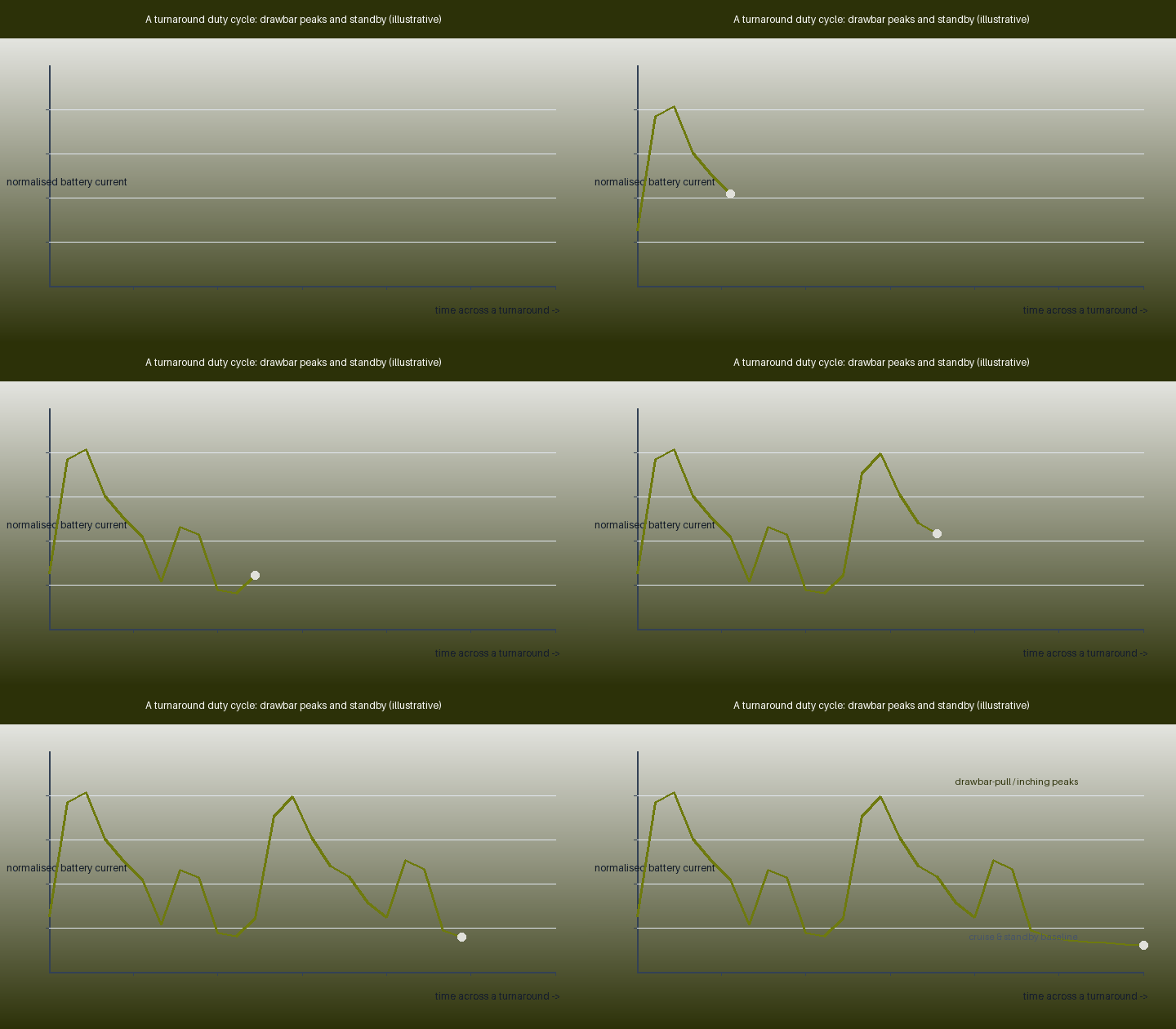
The single most useful thing to understand about a ramp vehicle is that its duty cycle is not a steady load. It is a sequence of short, high-current peaks separated by long periods of low current or idle. Consider a battery baggage tractor on a typical shift. It begins at the cargo building, couples to a train of loaded carts and pulls away; the instant of launch, and especially the launch on a gradient or with a heavy train, demands the highest current of the cycle as the motor develops drawbar pull to accelerate the entire rolling mass. Once the train is moving at ramp speed, current falls sharply, because far less torque is needed to keep it rolling than to start it. At the aircraft the driver decouples, and the tractor then spends a long interval manoeuvring, repositioning and waiting - using the inching control for precise, low-speed moves and sitting at standby while baggage is loaded. It then returns with another train, and the pattern repeats; between turns, and increasingly during scheduled breaks, the pack is opportunity-charged rather than waiting for a single overnight cycle. Published specifications make the contrast between peak and idle concrete. A representative electric baggage tractor is built around an 80 V battery of 500-625 Ah, drives a 40 hp (30 kW) AC motor and is rated for a drawbar pull on the order of 4,000 lb (1,814 kg), yet cruises at up to 18 mph (29 km/h) and turns within a radius of about 117 inches; the heavy battery, weighing roughly 1,160-1,510 kg, is itself the ballast that gives the machine traction. The first animated figure below traces this peak-and-idle profile qualitatively across a turnaround.
How a turnaround divides into load regimes (qualitative)
| Regime | What the pack sees |
|---|---|
| Launch / heavy pull | Highest current; motor develops peak drawbar pull to start the train |
| Cruising | Moderate, falling current once the train is rolling |
| Inching / manoeuvring | Short, repeated low-speed pulses near the aircraft |
| Standby / waiting | Long low-current intervals; opportunity charging when docked |
Where a traction vehicle converts battery energy into mechanical drawbar pull, a ground power unit converts it into the specific electrical power the aircraft expects, and that interface has two distinct forms. The direct-current form is the 28 V system: aircraft DC networks are described as 28 V nominal, with the supply regulated at about 28.5 VDC, and a DC ground power unit feeds the bus during maintenance and, in many installations, supports engine starting. The alternating-current form is the 400 Hz system: aircraft AC power is 115/200 V, three-phase, at a frequency of 400 Hz rather than the 50 or 60 Hz of ground grids, and an AC ground power unit generates this high-frequency power from the battery through an inverter. Some military aircraft instead use a 270 VDC network. The ratings attached to real battery power units show how demanding this conversion is. DC units are specified for maintenance and starting with clean, continuous current - up to several hundred amperes on the larger mobile models - while AC battery units are rated in the tens to hundreds of kilovolt-amperes to feed the full aircraft network; a widely deployed battery ground power unit, for example, supplies 400 Hz power across a 90-180 kVA range alongside 28 V and 270 V outputs and is rated for as many as 100 engine starts on a charge. The engineering discipline common to both forms is that the pack must deliver high current on demand - the brief surge of a start or the step load of systems switching on - while holding its output voltage within a tight band, a requirement that maps directly back to the same pulse-and-sustain profile seen in the traction fleet.
Bringing the duty cycle and the interface together defines the requirements the chemistry has to meet, and five properties dominate. The first is high-rate pulse delivery: the pack must supply launch and starting surges without its terminal voltage collapsing below the controller's cut-off or the aircraft's under-voltage threshold. The second is usable energy and endurance across a full shift, because a vehicle that returns to the charger before its work is done fails commercially even if every individual peak is met. The third, and often the decisive one on an open apron, is cold-ramp behaviour: low temperature simultaneously reduces the capacity a cell can deliver and raises its internal resistance, deepening the voltage sag under a pulse, so a pack sized at room temperature can be inadequate on a winter early turn. The fourth is durability in a harsh environment - sustained vibration from steel wheels on concrete, exposure to rain and de-icing fluids, and repeated multi-shift cycling over a service life measured in years. The fifth is safety and handling in dense, partly enclosed operating areas, from cargo buildings to packed gate complexes, where exhaust-free operation is the very reason the equipment is electric. These properties are coupled rather than independent: cold raises resistance, which worsens pulse voltage; high-rate cycling accelerates wear, which erodes endurance; and the way a manufacturer balances them is precisely what distinguishes a well-matched pack from an under-specified one.
Three battery chemistries appear in modern electric ground support equipment, and each occupies a different point in the trade-off space. The traditional electric tow tractor uses a flooded lead-acid pack - the 80 V, 500-625 Ah, well-over-a-tonne battery in the representative machine is characteristic of the type - which is inexpensive and provides useful ballast but is heavy, requires watering and maintenance, and loses usable capacity in cold and at high pulse rates. Newer electric vehicles, including high-voltage tractors and the latest battery power units, use lithium-ion packs, which are lighter, accept rapid and opportunity charging and need little maintenance, but introduce the thermal behaviour that calls for careful battery management and the air-transport and handling regime that applies to lithium. Nickel-metal hydride (NiMH) sits between them as a qualified alternative rather than a novelty: it supports high-rate pulse discharge for drawbar and starting peaks, performs well at low temperature, offers long cycle and service life, and uses an aqueous, non-flammable electrolyte that does not exhibit lithium-style thermal runaway, while avoiding the lithium-specific shipping burden when spare packs are moved between line stations. The honest qualification is that NiMH is not the dominant chemistry in today's eGSE fleet - lead-acid built the installed base and lithium leads many new programmes - but its combination of properties makes it a credible choice where cold performance, pulse duty, long life and intrinsic safety carry weight. The second animated figure traces the energy chain from the grid to the ramp, and the table below summarises the comparison.

| Chemistry | Strengths | Limitations |
|---|---|---|
| Lead-acid | Low cost; heavy pack gives ballast; long service record | Heavy; needs watering; weaker cold and pulse performance |
| Lithium-ion | Light; fast / opportunity charge; low maintenance | Thermal-management and lithium shipping requirements |
| NiMH | High pulse rate; strong cold performance; long life; aqueous and safe; no lithium shipping regime | Not yet the dominant installed chemistry; pack must be correctly sized |
Weijiang Power manufactures sealed nickel-metal hydride cells and matched industrial packs for ground support equipment and transport applications, alongside a broad range of industrial NiMH packs for aviation, marine, medical and stationary equipment, and supplies OEM and operator partners with a complete evidence file: high-rate pulse characterisation, low-temperature capacity and resistance data, cycle-life and endurance results, pack drawings with welded tabs and thermal protection, charge-control co-validation and a clear non-lithium transport statement. Send us your duty cycle - the drawbar-pull or starting peaks, the cruising and standby currents, the shift length and charging window, the lowest ramp temperature and the standards the vehicle must meet - and our engineers will size and validate a pack that holds its voltage through every pulse and finishes the shift with margin. Review the cell and pack range on the products page.


