How electrolyte tuning, alloy engineering and charge management keep NiMH cells delivering capacity and cranking power at -20C and below for outdoor, winter and emergency applications.
When the Thermometer Drops, Chemistry Slows Down
Batteries are famously sluggish in the cold, and NiMH is no exception — but the story is more nuanced than "cold kills the battery." A well-engineered NiMH cell can keep delivering useful capacity, cranking power and dependable charge acceptance down to -20°C and below, provided the electrolyte, alloy and charge regime are designed for it. For outdoor equipment, emergency lighting, winter-start applications, remote sensors and cold-climate consumer devices, understanding how NiMH behaves in the cold — and how to spec a cell that copes — makes the difference between a product that works all winter and one that fails on the first frost.
Why Cold Reduces NiMH Performance
Cold affects every part of the electrochemical system:
- Slower reaction kinetics — lower temperature slows the electrochemical reactions at both electrodes, reducing the current the cell can deliver at any given voltage.
- Electrolyte conductivity drops — the aqueous potassium-hydroxide electrolyte becomes more viscous and less conductive as it cools, raising internal resistance and limiting high-rate discharge.
- Reduced charge acceptance — a cold cell is far less willing to accept charge; the parasitic hydrogen-evolution reaction competes with charging, so energy that should store as hydrogen instead vents away as gas.
- Low-temperature capacity loss — the effective dischargeable capacity at -20°C can fall to a fraction of the room-temperature value, especially at high discharge rates.
The key insight: cold performance is not a fixed property but a function of design. Electrolyte composition, alloy formulation, electrode thickness and the charging regime can all be tuned to shift NiMH's cold window significantly.
Electrolyte and Alloy Tuning for the Cold
Manufacturers push NiMH's cold frontier through materials engineering:
- Electrolyte concentration and additives — optimising the KOH concentration (and in some designs adding mixed alkali such as LiOH or NaOH) changes the electrolyte's freezing behaviour and low-temperature conductivity. Additives can also suppress the parasitic reactions that steal charge in the cold.
- Alloy surface activation — the metal-hydride negative alloy is more prone to surface passivation in the cold. Activated, well-formed alloys with stable surface layers accept charge more readily at low temperature, improving cold charge acceptance and reducing pressure build-up.
- Thinner electrodes and higher surface area — thinner electrodes and higher active surface area reduce the distance ions must travel and lower internal resistance at temperature, helping high-rate (cranking) discharge.
- Low-temperature separators — a separator that retains electrolyte and stays wettable in the cold keeps ionic transport fast when the cell is chilled.
Cold Charge Acceptance: The Hidden Killer
Discharge in the cold gets the attention, but charge acceptance is often the bigger practical problem. Charging a lithium or nickel cell at very low temperature can cause plating or gas evolution, permanently damaging the electrode. For NiMH, charging a cold cell forces more of the current into the hydrogen-evolution side-reaction, generating gas, raising pressure and reducing how much energy is actually stored. A cell that "won't charge" in winter is usually a cell whose charge regime was not designed for the cold.
Modern chargers handle this with temperature-aware charging: sensing cell temperature and reducing charging current (or switching to a trickle/pulse regime) as the cell cools, so the chemistry stores energy rather than venting it as gas. When you design a cold-climate product, the charge profile can matter as much as the cell itself.
Practical Cold-Weather Performance
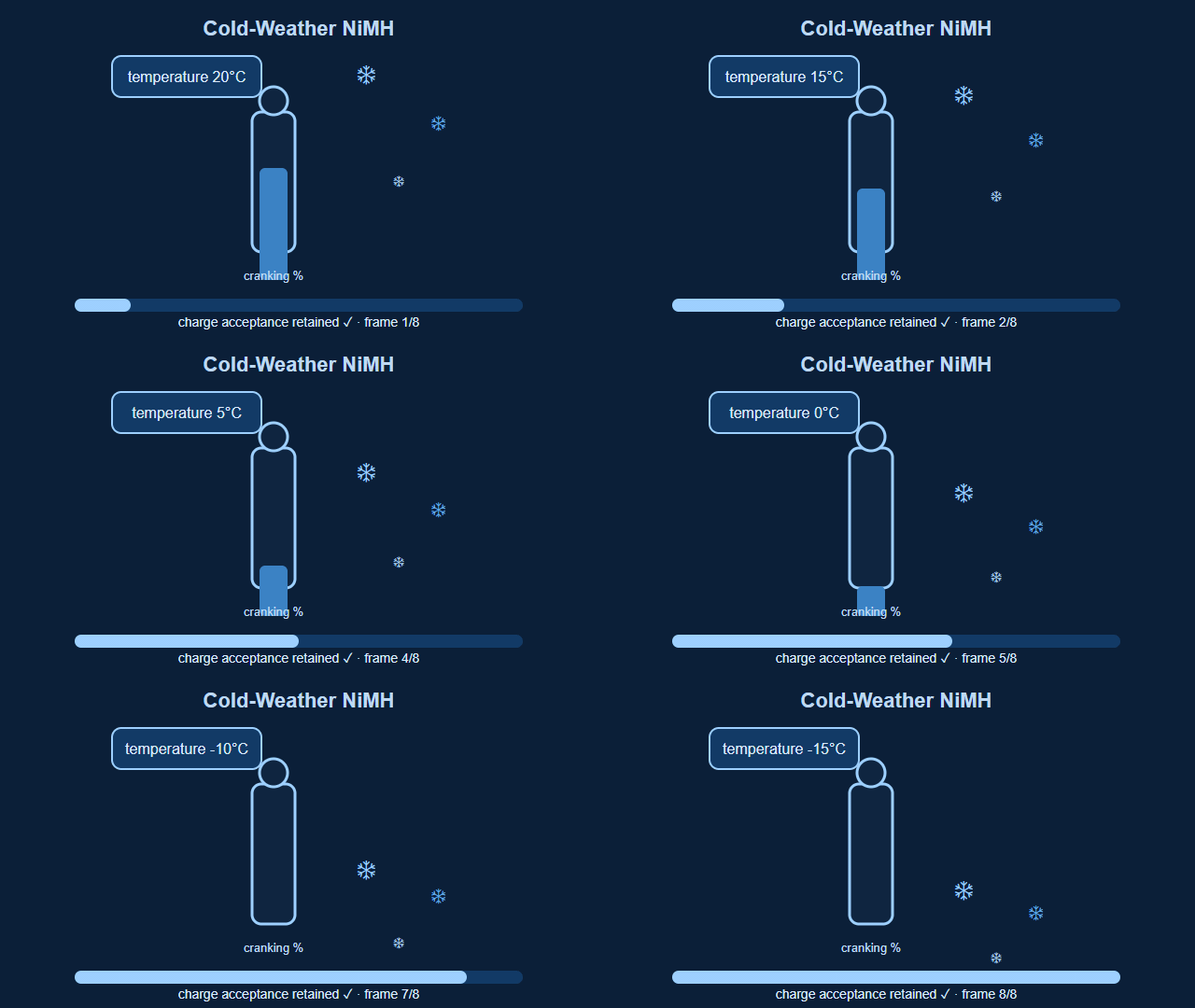
With proper design, a cold-tolerant NiMH cell holds a useful share of its capacity down to -20°C and retains meaningful low-current function even around -40°C. The exact numbers depend on discharge rate — at low drain (a remote sensor, a memory-backup cell) cold capacity retention is far better than at the high cranking currents demanded by a starter motor or a power tool. The engineering rule of thumb: match the cell's cold rating to your real discharge rate, not just to the label's low-temperature number.
Applications That Live in the Cold
- Winter-start and cranking — emergency starters, portable jump packs and cold-weather tools that must deliver a burst of power at low temperature.
- Outdoor and remote equipment — weather stations, wildlife cameras, remote sensors, solar-charged lighting and gate controllers that sit outdoors year-round.
- Emergency and safety lighting — emergency exit lights and standby luminaires in unheated corridors and outdoors, where backup power must be available on a freezing night.
- Cold-climate consumer devices — flashlights, radios and camping gear for users in regions with harsh winters.
How to Specify a Cold-Rated NiMH Cell
- Demand cold capacity data — ask for capacity retention at -20°C (and -40°C if relevant) at your actual discharge rate, not just a room-temperature datasheet.
- Check cold charge acceptance — verify the cell can be charged at low temperature without excessive pressure or capacity loss; ask how the included charger manages temperature.
- Test cranking/pulse at temperature — if your application needs a power burst in the cold, measure the voltage sag under pulse load at -20°C.
- Consider self-discharge in the cold — low self-discharge (LSD) NiMH retains charge better during long cold storage, important for seasonal emergency devices.
Cold Is a Design Problem, Not a Dead End
NiMH does not love the cold, but it can be engineered to work there. With tuned electrolyte, activated alloys, thinner electrodes and temperature-aware charging, a cold-rated NiMH cell delivers dependable capacity and cranking power through a real winter — making it a strong, safe and recyclable choice for outdoor, emergency and cold-climate applications that need a battery they can trust when it freezes.
Weijiang Power Cold-Rated NiMH
Weijiang Power engineers and grades NiMH cells for low-temperature duty, with electrolyte, alloy and electrode designs tuned for cold cranking and dependable outdoor operation. We publish capacity, charge-acceptance and pulse data across the operating window, so you can specify a cell that works where you actually use it. Share your temperature profile and duty — we will match the cell that keeps its charge when the mercury drops.
Series · NiMH Engineering Deep-Dives
Related Reading


