A programmable controller is sold as industrial equipment, and its retention subsystem does not escape that qualification. The campaign combines the equipment-level requirements of IEC 61131-2 - the PLC standard that, among many other clauses, defines how a controller must withstand voltage dips and supply interruptions - with industrial EMC in the IEC 61000-6 series, the IEC 60068 environmental sequence, the industrial-control equipment requirements represented in North America by UL 508A, and, when the controller feeds safety functions, the functional-safety standards. Layered on top are the tests unique to retention: repeated power interruption with verification that retentive data and the real-time clock survive, long-off retention at temperature extremes, orderly-save hold-up measurement, and field-replacement safety. Finally the rechargeable source carries its own evidence under IEC 61951-2 for performance, IEC 62133-2 for safety and UN 38.3 for transport. This final paper maps that complete campaign for a nickel-metal hydride retention module, showing how the battery behaviour is woven into the controller's type tests - including the subtle requirement that a controller must behave deterministically when its backup is near exhaustion - and why a cell supplier that provides complete, lot-traceable NiMH documentation shortens the route to a certifiable, globally shippable controller or CNC.
IEC 61131-2 specifies equipment requirements and tests for programmable controllers, including supply voltage ranges and, crucially for retention, immunity to voltage dips, short interruptions and ripple. Test generators apply defined interruptions of varying duration; the controller must either ride through or resume in a defined, safe state with retentive data intact and no corruption of the user program. These tests directly exercise the supervisor, hold-up capacitor and backup switchover.
A rechargeable retention design passes these cases deterministically because the hold-up capacitor covers the millisecond ride-through and orderly save while the NiMH module preserves the retained domain across longer breaks. The standard's requirements are functionally paralleled in installation practice by UL 508A for industrial control panels in North America, which shapes how the retention module is fused, labelled and mounted in the panel.
Beyond the generic dip tests, a retention-bearing controller needs a dedicated validation campaign: interrupt the supply for durations from milliseconds to the full targeted off-power interval, at high and low temperature and at low backup state of charge, then verify every retentive tag, counter and the RTC against their pre-interruption values. The orderly-save sequence is captured to confirm the hold-up reservoir always lets the CPU finish its flush before the logic rail collapses.
Long-off retention is validated by real and accelerated storage, comparing measured data survival against the self-discharge-and-standby-current model; RTC accuracy is checked against its specified drift (a few tens of seconds per month at 25 degrees C in typical controllers); and the low-backup alarm path is exercised so the controller signals exhaustion predictably rather than silently losing data. These cases must be run at the backup's worst case, not only when freshly charged.
Controllers meet IEC 61000-6-2 industrial immunity and IEC 61000-6-4 emissions, covering ESD, radiated and conducted RF, surge and fast transients on the very supply and I/O lines that carry the disturbance causing the power interruption in the first place. The retention rail and switchover path must not false-trip or latch during a burst, and a transient during the powered-to-backup handover must not corrupt retained memory.
Layout and decoupling around the NiMH module - a low-impedance backup rail, local reservoir capacitance and a clean comparator reference - are verified during these immunity tests, with the most severe cases repeated at low backup charge to expose any interaction between a higher-impedance aged cell and supply-borne disturbance.
The IEC 60068 sequence applies cold, dry heat and damp heat across the controller's rated range, plus vibration and bump representative of panel and machine mounting. Retention is unusually temperature-sensitive: both NiMH self-discharge and CMOS leakage rise with temperature, while available battery voltage falls in the cold, so the long-off retention test is deliberately repeated at both extremes rather than only at 25 degrees C.
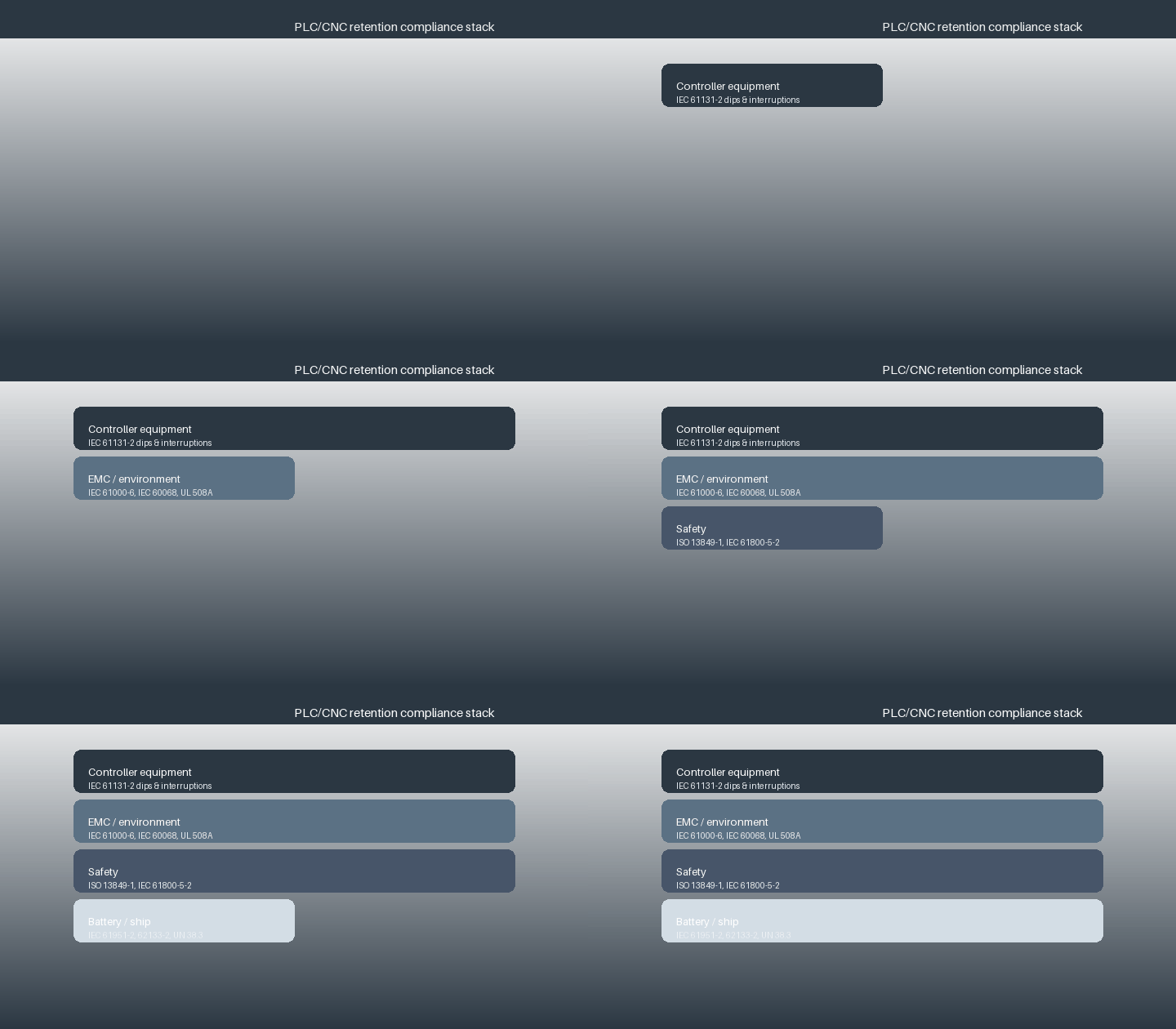
Mechanical tests confirm the pluggable module, cell tabs and connectors maintain contact under vibration, and thermal cycling verifies that repeated expansion and contraction does not open the retention path. The first animated figure layers the standards stack; the second sequences the whole qualification campaign from dip tests to the integrated technical file.

When retentive state or position feeds a safety-related function, the controller's behaviour under backup exhaustion belongs in the ISO 13849-1 / IEC 61800-5-2 analysis: loss of retained position must be detectable and must lead to a safe state, not an unexpected restart. A monitored rechargeable module - whose health is readable and whose charge is maintained in normal operation - provides better diagnostic coverage than an unmonitored primary cell with an unknown remaining life.
Field-replacement is designed for safety: keyed, polarised connectors, insulation that meets IEC 61131-2 clearance requirements, no exposed live parts, and - thanks to the local reserve - no requirement to keep the control powered while swapping the module, eliminating the hazardous and error-prone five-minute hot-swap ritual of legacy CNC lithium packs.
The sealed NiMH cells carry their own standardised dossier: IEC 61951-2 performance tests for capacity, charge retention, endurance and internal resistance, extended with the ultra-low-current and wide-temperature data retention duty demands; IEC 62133-2 safety requirements under charge, forced discharge, external short, vibration, shock, free fall, thermal abuse, crush and pack-level faults; and UN 38.3 transport tests, under which NiMH - being non-lithium - moves more simply than lithium service cells, a genuine advantage for a global spare-parts chain.
The final technical file integrates the IEC 61131-2 interruption and dip cases passed at backup worst case, IEC 61000-6 and IEC 60068 results, the retention and RTC validation records, any functional-safety analysis and the three battery documents. A supplier that delivers matched, wide-temperature NiMH cells with complete paperwork and engineering support for the interruption and long-off tests removes the most variable element from that file, letting the controller or CNC maker certify a product that powers back up into the correct, safe state every single time.
Weijiang Power designs and manufactures sealed nickel-metal hydride cells and matched industrial packs for remote, off-grid and safety-related equipment, and supports OEM partners with IEC 61951-2 performance files, IEC 62133-2 safety evidence, pulse-load characterisation, wide-temperature testing and charger/pack co-validation. Tell us your duty cycle, peak current, temperature envelope, autonomy target and the standards your product must meet, and our engineers will specify a cell-and-pack combination that protects runtime, reliability and service life. Review the range on the products page.


